Why validating your people, processes, and technology is the next evolution of cybersecurity.
Organizations have never invested more in cybersecurity.
Security Operations Centers (SOCs), Endpoint Detection and Response (EDR), Security Information and Event Management (SIEM), Multi-Factor Authentication (MFA), Zero Trust architectures, cloud security, vulnerability management, and threat intelligence have become standard components of modern security programs.
Yet despite these investments, many organizations still struggle to answer one critical question:
Are we actually prepared for a real cyberattack?
Knowing that security tools are installed is not the same as knowing they will perform when an attacker begins moving through your environment. A compliance assessment may confirm that controls exist, and a penetration test may identify exploitable vulnerabilities, but neither guarantees that your organization will detect malicious activity, coordinate an effective response, or recover quickly.
Cyber resilience requires more than technology. It requires confidence.
Purple Team Exercises provide that confidence by validating security controls, strengthening incident response, and helping organizations continuously improve their ability to defend against modern threats.
What Is a Purple Team Exercise?
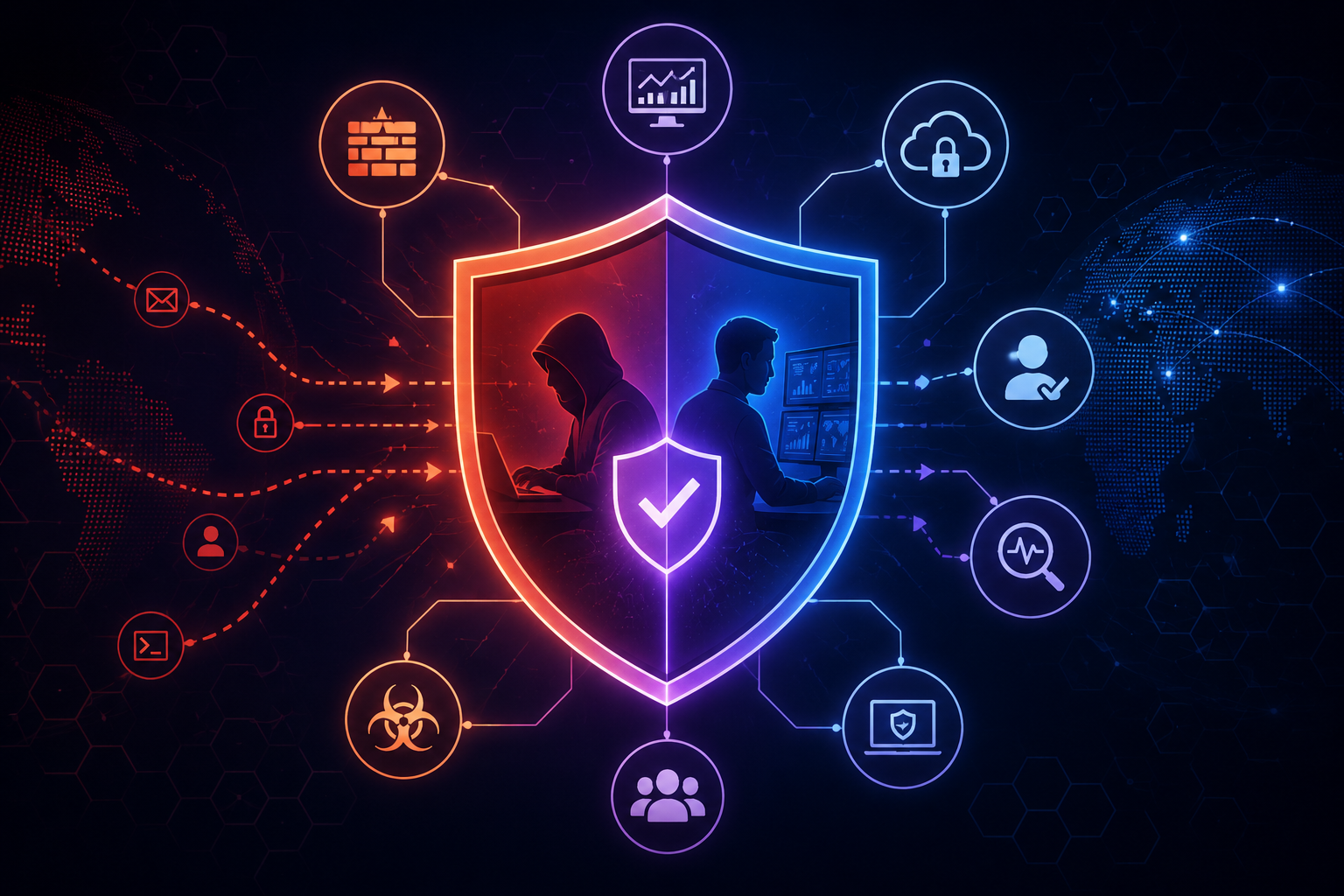
A Purple Team Exercise is a collaborative security engagement that brings offensive and defensive teams together with a shared objective: improving an organization’s overall security posture.
Traditionally, Red Teams simulate real-world attacks while Blue Teams focus on monitoring and defending systems. In a Purple Team Exercise, those teams work together throughout the engagement rather than operating independently.
Instead of simply identifying vulnerabilities, the exercise validates how well security controls, detection capabilities, response procedures, and personnel perform during realistic attack scenarios.
The goal isn’t to “win.”
The goal is to learn.
Every simulated attack becomes an opportunity to improve visibility, strengthen defensive processes, and build organizational resilience before facing an actual adversary.
The Shift from Finding Vulnerabilities to Validating Defenses
For many years, cybersecurity assessments focused on identifying weaknesses.
Questions like these drove security testing:
- Can an attacker gain access?
- Which systems are vulnerable?
- What software needs to be patched?
Those questions remain important.
But today’s threat landscape demands another question:
If an attacker succeeds, how quickly will we know?
Modern attacks often unfold over days or weeks. Threat actors may steal credentials, move laterally, escalate privileges, and establish persistence long before ransomware is deployed or sensitive information is exfiltrated.
Purple Team Exercises help organizations evaluate whether they can identify those activities early enough to stop them.
Rather than measuring whether an attack is possible, Purple Teaming measures how effectively an organization detects, investigates, contains, and recovers from that attack.
Security Validation: Moving Beyond Assumptions
Many organizations assume their security controls are functioning because dashboards appear healthy and alerts are being generated.
However, cybersecurity isn’t about assumptions.
It’s about validation.
Purple Team Exercises intentionally challenge security controls to answer questions such as:
- Will the SIEM detect suspicious activity?
- Is endpoint protection identifying attacker behavior?
- Are firewall rules configured effectively?
- Can identity protections detect privilege escalation?
- Are security analysts receiving the right alerts?
- Do response procedures work as expected?
Instead of relying on theoretical protection, organizations gain measurable evidence that their security investments are performing as intended.
That evidence is invaluable for security teams, executives, auditors, and leadership alike.
Realistic Threat Simulation Creates Real-World Readiness
Cybercriminals rarely rely on a single technique.
They combine multiple tactics to achieve their objectives while avoiding detection.
Purple Team Exercises replicate these behaviors using scenarios based on current attacker techniques, including:
- Phishing and social engineering
- Credential theft
- Privilege escalation
- Lateral movement
- Active Directory compromise
- Ransomware deployment
- Cloud identity attacks
- Insider threats
These exercises allow organizations to observe how their own environment responds—not in theory, but in practice.
Security teams can validate detection logic, improve monitoring rules, refine response playbooks, and strengthen collaboration while the exercise is taking place.
The result is continuous improvement rather than a static assessment report.
Cybersecurity Is More Than an IT Responsibility
When a significant cyber incident occurs, the impact extends well beyond technology.
Business operations, finance, legal, communications, human resources, and executive leadership all play important roles during an incident.
Questions quickly emerge:
- Who communicates with customers?
- How will payroll continue?
- Who authorizes major decisions?
- What if systems remain unavailable for several days?
- How are regulatory reporting requirements handled?
Purple Team Exercises often include executive and operational stakeholders to validate business continuity alongside technical response.
Testing these processes before an incident occurs builds confidence across the entire organization and helps reduce confusion during real-world events.
Continuous Improvement Through Collaboration
One of the greatest strengths of Purple Teaming is collaboration.
Rather than producing a report weeks after testing is complete, offensive and defensive teams work together throughout the exercise.
This collaborative approach enables organizations to:
- Improve detection engineering
- Tune security monitoring
- Validate incident response procedures
- Enhance analyst skills
- Strengthen communication
- Prioritize remediation activities
Each exercise becomes an opportunity to increase organizational maturity.
Security is no longer viewed as a yearly assessment.
It becomes an ongoing process of validation and improvement.
SCPTP
SynerComm Purple Team Platform (SCPTP).
SynerComm Purple Team Exercises now run on SCPTP, our platform built specifically for this kind of real-time, structured validation. Every technique is mapped to MITRE ATT&CK, every detection outcome is captured as it happens, and every engagement builds on the last rather than starting from a blank page. You can read more about how SCPTP works here: Purple Team Platform for Real-Time Security Validation – SynerComm
Measuring Success
A successful Purple Team Exercise isn’t measured by the number of vulnerabilities discovered.
Instead, success is measured by improvements in security readiness.
Organizations can evaluate progress by asking:
- Were simulated attacks detected?
- How quickly were alerts investigated?
- Were response procedures followed?
- Did communication flow effectively?
- Were business operations maintained?
- What improvements should be implemented before the next exercise?
These insights provide meaningful metrics that demonstrate progress over time and help guide future security investments.
The SynerComm Approach
At SynerComm, we believe cybersecurity assessments should produce measurable improvements, not simply findings.
Our Purple Team engagements are designed to help organizations validate the effectiveness of their people, processes, and technology through collaborative, realistic testing.
Our services can include:
- Purple Team Exercises
- Threat simulation
- Security control validation
- Penetration testing
- Executive and technical tabletop exercises
- Network and security assessments
- Incident response evaluations
- Actionable remediation planning
Rather than delivering a report and walking away, we work alongside your team to strengthen defenses, improve operational readiness, and build long-term cyber resilience.
Every engagement is tailored to your environment, risk profile, and business objectives.
Build Confidence Before an Attacker Tests You
No organization can prevent every cyberattack.
But every organization can improve its ability to detect, respond to, and recover from one.
Purple Team Exercises provide the insight needed to validate security investments, strengthen defensive capabilities, and prepare organizations for the realities of today’s threat landscape.
Cybersecurity isn’t measured by the number of tools you deploy.
It’s measured by how effectively your people, processes, and technology work together when it matters most.
If you want confidence that your defenses are ready before an attacker puts them to the test, a Purple Team Exercise is one of the most effective ways to get there.